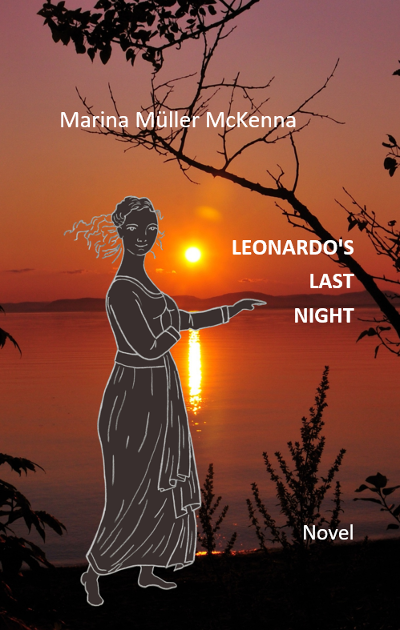
Reader´s opinions about the German Original:
I was transported to another world, learned a great deal, and am very impressed by what the author offers the reader about this fascinating personality in her own unique way. A historical novel full of suspense, but also packed with information about Leonardo's paintings, which will surely inspire you to pick up an art book again or visit a museum. My utmost respect for this novel. I believe Leonardo himself would be impressed if he could relive his life and death in this way. The author has once again succeeded in writing a good book, perhaps her best, and I hope it won't be her last. - S.L., Proofreader
A reader writes on Amazon:  Well-written,
entertaining, knowledgeable, very interesting, and multifaceted.
Well-written,
entertaining, knowledgeable, very interesting, and multifaceted.
Very easy to read, never boring. Many well-known and suspected details from Leonardo's life are woven into a compelling story. The author succeeds in approaching the person behind the much-celebrated, then forgotten, and rediscovered genius Leonardo da Vinci in an engaging way. Many details, quotes, and facts are woven together to create a coherent portrait of a multifaceted personality and the stages of his life. Highly recommended in my opinion. - R. H.
I really like the book's concept; hour by hour, until his death, Leonardo's life is recounted from his own perspective. Bravo! A beautiful book. - G.H., Proofreader
Now for the good things in my life, and this wonderful book is one of them. It reads smoothly, and the language is beautifully melodic. I'm completely immersed in the story. - D.S., Reader
I like the cover. And I personally really like the subject matter. Lots of information, beautifully and interestingly presented. And for me, a completely new perspective on Leonardo. Of course, I had to look up every painting mentioned in the book more closely online. Fascinating, and I learned a lot! - H.M., Proofreader
I really like your new book! I enjoyed reading it. You wrote it wonderfully, and I liked the language too!
I really like your new book! Respect for your work. - M.O., reader and friend
I've almost finished your book and can only say: Congratulations on this book, it's simply magnificent. All those little historical details and the impressive portrayal of Leonardo's life. Simply superb. - M.B., reader
R. is currently reading your book. We already agree: It's a great read. The idea is good, it's captivating, and one wants to keep reading. That's what I call a successful novel, entertaining and interesting at the same time. Thumbs up! - A.H., reader and friend
I read this book a while ago. I was deeply impressed by how you described his inner life, his work, and the historical events surrounding him during that time. A truly magnificent book. Whenever I hear, see, or read a report about Leonardo, your book comes to mind again, and I simply can't imagine that anyone else could write about this artist with such precision and empathy. - M.B., Reader
The book is a very good read – (...) I was impressed ... I'm almost at the end now and keep wondering if she (the protagonist – author's note) will get her question answered – this suspense runs through the entire book! I have absolutely no idea how much of the content is real and how much is fiction – but it's such a page-turner and I find it very interesting! - A.S., Reader
(Author's note: The direct events in Leonardo's life described in the 12 chapters ("Hours") are – with the exception of one fictional character that is based on assumptions – authentic and are based on serious research into Leonardo's life and work. Quotes are taken from Leonardo's notebooks or documented statements. The framing narrative, however, contains various artistic liberties.)
Frequently Asked Questions about the Novel "Leonardo's Last Night"
Since its publication, I've received numerous questions from my readers about this book, which I'd like to answer here.
Q: How long did you work on this book?
A: This novel is the longest literary "pregnancy" I've ever carried. I nurtured the idea for this book for over 50 years before I was able to bring it to fruition. I spent about a year researching and another year writing.
Q: Can one read "Leonardo's Last Night", which you wrote as part of a trilogy, even if one hasn't read the two previous novels, "Many Bridges - One River" and "Tropic of the Evening Sun"?
A: Absolutely. Leonardo is only loosely connected to these novels. Those unfamiliar with "Many Bridges - One River" and "Tropic of the Evening Sun" might only be slightly confused at the very beginning. Only on the first few pages and at the very end are there references to "Tropic of the Evening Sun". As the text on the book cover says, this is a fusion of me as the author with my protagonist Ariane from the "Bridges" and the "Tropic". Leonardo is the book that Ariane writes in the "Tropic"-novel, and she dies after finishing it. That's why Jean-Alain Marville, who is also fictional, is listed in the dedication. But everything from page 9 (the prologue) to page 158 is the novel as I would have written it, even without its predecessors.
Q: So that means the second person in the dedication is real?
A: Yes, it's for my friend Johanna Siebert, an elderly lady in Rangsdorf near Berlin, who introduced me to Leonardo da Vinci when I was 11 years old. Despite our age difference, we had a magical, very beautiful friendship. I also watched the first manned moon landing with her on television while eating her wonderful elderberry soup. Ever since, I always taste elderberry when I see pictures of Armstrong on the moon. Johanna introduced me to classical music, and we went to the cinema to watch films like Konrad Wolf's "Goya." And she gave me a book about Leonardo. Since then, I've been "infected," reading everything I could get my hands on about the artist and delving deeply into his life. In that sense, Johanna is the initiator, the trigger, of the desire to one day write "my" book about Leonardo. After half a century, I've now made it a reality.
Q: So, you were practically a Leonardo expert since childhood and just whipped up this relatively slim volume?
A: Absolutely not! Of course, I knew a lot about Leonardo, but much of it had lain dormant during my adult years. Throughout life, one goes through phases, focusing on completely different things. Furthermore, I wasn't nearly as familiar with the people around Leonardo, the places he lived, or the politics of the time. And I hadn't studied some of his paintings as closely as others did. In addition, new information about certain works by the artist had come to light over the years. Just think of the controversial and now mysteriously vanished "Salvator Mundi." – No, it required very intensive research; much more so than was necessary for the two previous fictional novels. Even though I had done a lot of research for those as well, to ensure that I portrayed places and landscapes authentically. As a perfectionist, I don't like to live in a fantasy world, even in my writing.
Q: How much of the Leonardo novel is absolutely authentic or documented, and how much is invented?
A: As I said, I strove for absolute fidelity to the sources regarding all facts and people. As far as Leonardo's life is concerned, and as far as evidence can be found, I haven't invented anything. Quotes are taken from Leonardo's notebooks or documented statements. Of course, the framing narrative with Marguerite at Leonardo's deathbed is fictional and never actually happened. I'm in good company in this regard, as even King Francis I cheated in claiming to have received Leonardo's last breath, even though he wasn't near him at the time. This framing narrative idea, however, gave me access to my topic: Leonardo and women. Two things, though, are indeed due to the author's artistic license: the character of Giovanna and the onion marmalade. It has often been speculated whether Leonardo ever had a sexual relationship with a woman, and it has been considered plausible. I share this view, and that's how Giovanna came into the book. And while the onion marmalade isn't documented, it's quite possible to be found in a vegetarian Italian Renaissance household. As I was writing this, I was making it myself, and so ... this delicacy made it into the book.
Q: Does the protagonist (Marguerite) ultimately get her big question answered?
A: As one reader aptly describes it: This suspense runs throughout the entire book, and that's how it should stay. In the end, it will all be answered anyway—hopefully!—for every single reader.